
भा.कृ.अ.प. - भारतीय कृषि अनुसंधान संस्थान झारखण्ड
ICAR-Indian Agricultural Research Institute Jharkhand
भा.कृ.अ.प. - भारतीय कृषि अनुसंधान संस्थान झारखण्ड
ICAR-Indian Agricultural Research Institute Jharkhand
1. Schedule Caste Sub Plan
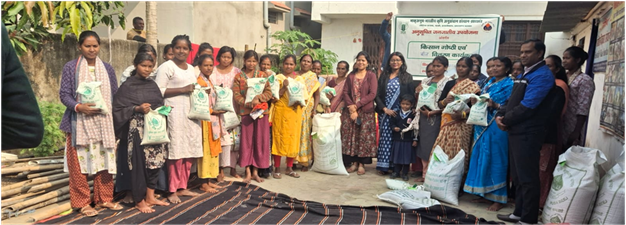
In order to increase the income of the target population through various income generating schemes, skill development and infrastructure development, ICAR-IARI, Jharkhand has effectively implemented the Schedule Caste Sub Plan (SCSP) for the benefit of schedule caste farmers of Jharkhand in an effective manner. Various developmental activities are underway for the creation of infrastructure facilities, conducting capacity building training programs and farm input supply for enhancing agricultural productivity. Under the farm-input supply component, seeds and planting materials of various agricultural and horticultural crops, fertilizers and other required input is being distributed free of cost among the selected beneficiaries of the community as per the seasonal requirements. Direct input supply to the needy farmers help in enhancing the standard of living of scheduled caste farmers by increasing their income through increased agricultural productivity. Efforts of the institute in supplying quality seeds under SCSP is highly appreciated by the benefitted farmers and there is a great demand for the quality seeds of various crops in all the cropping seasons. During Kharif 2022, a four days ‘Training cum seed distribution program of paddy for improved productivity’ were organized during 04th to 07th July 2022 to impart knowledge of improved cultivation practices for cultivation of new improved rice varieties and 30 Q of paddy seeds were distributed among 220 number of beneficiary farmers of 4 villages of Barhi block of Hazaribag district. During Rabi 2022-23, 24 Quintals of wheat seeds was distributed among 300 scheduled caste farmers of 5 different villages in 3 panchayats of Hazaribag district during five days ‘Training cum seed distribution program of wheat for improved productivity’ during 25th to 29th November 2022. During the farmers training cum seed distribution program the farmers were actively interacted with crop-specific resource personnel of the institute. The aim of the farmer’s training program was to provide brief insight into the scientific package of practices of different crops for higher productivity and consequently higher income.
2. Tribal Sub Plan
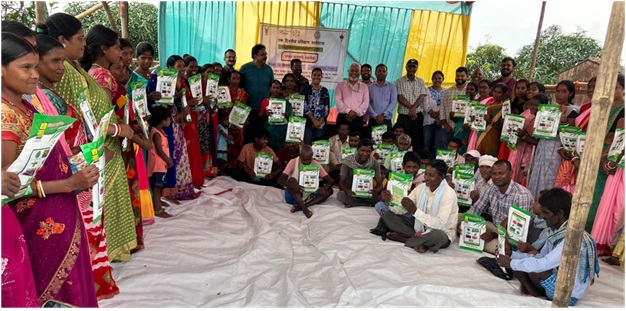
As part of TSP, ICAR-IARI is actively engaged in enhancing the standard of living of tribal farmers by increasing their income through increased agricultural productivity. Under TSP, training programme is conducted for both Kharif and Rabi season. Based on the demands of farmers the inputs are procured for distribution among tribal farmers. Under this one farmer’s training conducted on Improved agriculture practices for Kharif. Under the TSP initiative, a Farmer’s Training cum Seed Distribution Programme on “Improved Agricultural Practices for Kharif” was organized at different villages of Bishnugarh block (Kharna, Alkhari, Jarva, Jamnizara) and Chauparan block (Jagodihnima, Pipra, Dayhar). A total of 109 beneficiaries were benefitted from this programme. After training paddy, Pigeon pea, maize and vegetable kits were distributed among farmers as hand holding support and improved livelihood.
A specialized training programme on “Advanced Gardening Techniques” was conducted on 12th September 2025 in collaboration with Pradhan, Bokaro, wherein 95 farmers participated and benefitted through hands-on training sessions and input distribution.
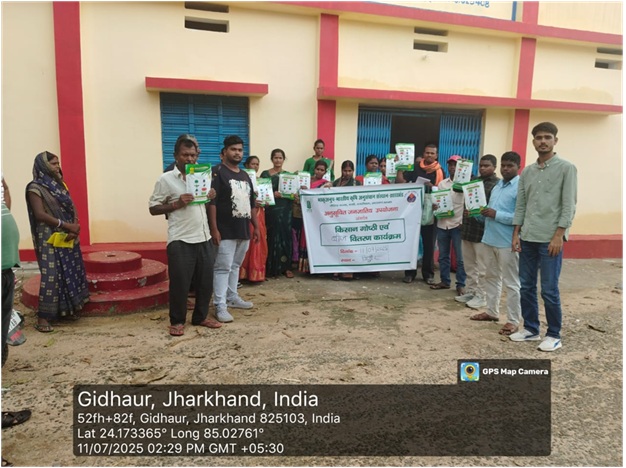
In addition, Scheduled Tribe (ST) beneficiaries from various villages across Dari, Daru, Ichak, Barhi, Katkamsandi, Tatijhariya, Sadar, and Bishnugarh blocks of Hazaribagh district, Giddhour block of Chatra, and different blocks of Khunti (Karra), Ranchi, Gumla (Bharno, Sisai) and Simdega (Kolebira) districts were provided with technical training on the cultivation of Kharif crops.
A total of 840 farmers benefitted from the programme. After the training sessions, paddy, pigeon pea, maize, and vegetable seed kits were distributed among the farmers as a part of handholding support to promote improved livelihoods and sustainable agricultural development.
Kisan Mela cum Sangoshthi Empowers Tribal Farmers in Gaurwa Village, Hazaribagh
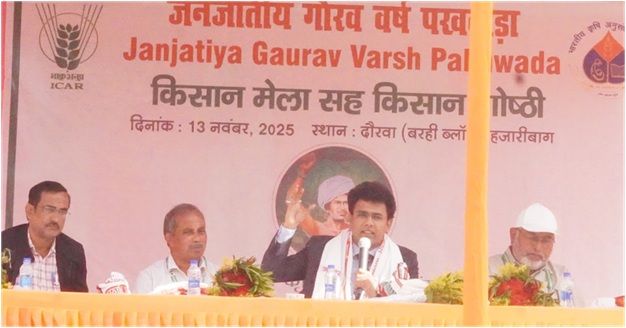
As part of the Janjatiya Gaurav Varsh Pakhwada 2025, a Kisan Mela cum Sangoshthi was organized at Gaurwa village, Barhi block, Hazaribagh, Jharkhand. The programme aimed to empower tribal farmers from Gaurwa and neighbouring villages by enhancing awareness, promoting scientific farming practices, and linking them with institutional support systems. Shri Anand Sharma, IAS (Probationer), Hazaribagh, graced the occasion as the Chief Guest. In his keynote address, he urged farmers to embrace “Parivartan aur Vishwas”—change and confidence—by adopting modern technologies, participating in institutional trainings, and transforming their identity from kisan to vyavasayi (entrepreneurial farmer). He described farmers as “Prakruti ke Vaigyanik” (scientists of nature) and encouraged them to utilise government schemes and scientific knowledge for better productivity.
Shri Rakesh Kumar, Block Technology Manager (BTM), Barhi, and Shri Bina Oraon, Ex-Gram Pradhan, also graced the occasion. As part of programme the Institute organized an Agriculture Exhibition to showcase improved agricultural technologies and practices suitable for tribal farming communities. The exhibition featured displays on high-yielding and climate-resilient crop varieties, livestock production technologies, soil health management, water conservation techniques, biofertilizers and value-added agricultural products to create awareness among tribal farmers and rural youth. In extension Kisan Sanghosthi held to provide scientific guidance and practical solutions to tribal farmers on various agricultural topics. Scientists from the Institute delivered interactive sessions on key areas including improved crop production practices, soil health and nutrient management, climate-resilient agriculture, pest and disease management, livestock rearing, fodder production, water conservation techniques, millet cultivation, and opportunities in agro-based entrepreneurship. Farmers raised queries related to crop diseases, input management, animal health, and market linkages, which were addressed by experts during an open discussion session. The Sanghosthi helped enhance farmers’ knowledge, promoted adoption of improved technologies, and encouraged diversification of farming systems for better income and sustainability.
The institute also expressed its intent to adopt Daurwa village for targeted interventions aimed at enhancing livelihood opportunities and income generation. Over 200 farmers participated in the mela, which concluded with the distribution of vegetable seed kits to tribal farmers—reaffirming the commitment to practical support and inclusive rural development.
For rabi season a Farmer’s Training cum Seed Distribution Programme on “Improved Agricultural Practices for Rabi” was organized at different villages of Bishnugarh, Barhi, Tatijhariya, Barkatha, Chouparan, Daru, Sadar, Churchu, Gidhour, Ichak block of Hazaraibagh district. Some tribal dominated villages of district Gumla, Khunti, Simdega and Ranchi were also covered. A total of 699 beneficiaries were benefitted from this programme. After training improved and region suited variety of wheat, mustard, chick pea, lentil and vegetable kits were distributed among farmers as hand holding support and improved livelihood.
3. Training program organized under NABARD funded project
A three day training program on the topic “झारखण्ड में गुणवत्तायुक्त प्रोटीन मक्का के एकल संकर मक्का बीज उत्पादन की तकनीक विषय पर त्रिदिवसीय युवा कृषक प्रशिक्षण कार्यक्रम” was organized under NABARD funded project “Popularization of bio fortified maize hybrids (QPM+ProVit.A enriched) for sustainable nutritional security and upscaling entrepreneurship to boost up farmers’ income in Jharkhand” to train and motivate the youth farmers to produce the hybrid seeds of maize as there is huge demand of quality hybrid seeds of maize among the farmers of Jharkhand. The training was attended by 60 farmers of 10 Farmer Producer Organizations of Hazaribag district.
4. Seed distribution
5. FLDs conducted/Field day/Farmers day organized
| S. No. | Block | No. of Villages | GY (Pusa HQPM-1 improved) | GY (Pusa HQPM-5 improved) | Yield of traditional variety | Yield of hybrid available in market |
|---|---|---|---|---|---|---|
| 1 | Barhi | 5 | 53.2 | 56.1 | 18.1 | 46.8 |
| 2 | Hazaribag | 5 | 54.1 | 57.8 | 19.4 | 45.5 |
| 3 | Churchu | 5 | 55.6 | 56.4 | 18.4 | 49.4 |
| 4 | Dadi | 5 | 53.8 | 57.9 | 19.5 | 50.2 |
| 5 | Gidhi | 5 | 57.5 | 58.5 | 18.6 | 52.1 |
| 6 | Ichak | 5 | 56.9 | 58.7 | 18.0 | 48.6 |
| 7 | Vishnugarh | 5 | 57.1 | 57.2 | 20.3 | 47.7 |
| 8 | Tatijhariya | 5 | 56.4 | 59.2 | 17.9 | 49.2 |
© ICAR-IARI JHARKHAND 2025. Design by AKMU, ICAR-IARI Jharkhand, Hazaribagh, Jharkhand. Hosted at AKMU, ICAR-IARI New Delhi.